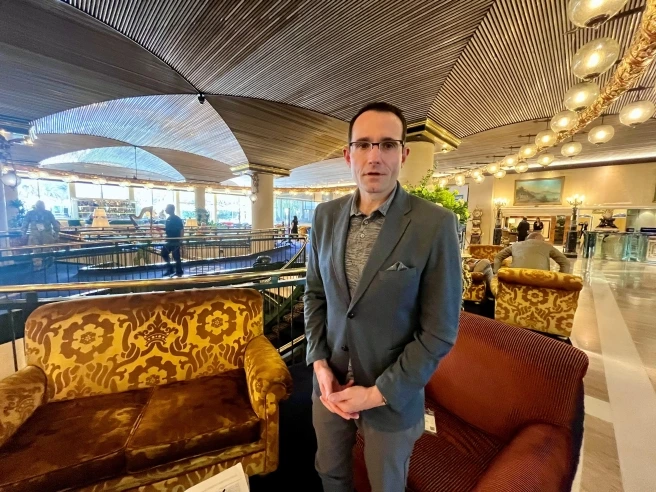
An entire aircraft designed by artificial intelligence agents: William Roper, co-founder and CEO of Istari Digital, believes we could see one as early as next year. But trusting the result requires one condition: “independent checks outside the model” to verify the work without leaving AI to certify itself. “A system cannot be its own inspector,” he says in this exclusive interview with Corriere della Sera, conducted during the Global SOF European Symposium, an international gathering dedicated to special operations forces that brings together military personnel, government representatives and defense companies, held in Rome from October 6 to 8.
«Blue Origin used agents and the guardrails my company helps put in place to have AI design a battery for use on the Moon. The entire process, from requirements to design, simulations and manufacturing, was controlled by artificial intelligence. Equally significant, however, was that every step, every piece of data and every test could be independently audited outside the AI system itself. This allowed Blue Origin’s compliance officers and lawyers to establish that the work met their safety and integration requirements and all the required business standards,” Roper says. Following procedures, however, “does not guarantee that the work done by AI is correct, only that it complies with the rules.” In other words, “even when it stays within the guardrails, AI can produce the wrong result,” he explains.
Formerly responsible for U.S. Air Force acquisitions and an Honorary Group Captain in the Royal Air Force, Roper co-founded Istari Digital in 2022 to enable companies to design complex systems and collaborate while retaining control of their data and intellectual property. Ex Google CEO Eric Schmidt was among its early investors. The company works with the U.S. Air Force and companies including Blue Origin and Lockheed Martin.
What changes with agentic AI?
“Agents can coordinate numerous activities and carry them out much faster than people. Some companies I work with design systems in days that previously took years or months. The risk of using agents is that AI makes mistakes too, so we need to build verification systems that ensure a safe, verifiable result. If we build an AI factory properly, the prompt—the instruction given to AI—will become the product. But before using AI’s superpowers, we need guardrails: control mechanisms that assure us the agents have done their work safely and responsibly.”
What is the AI factory you are referring to?
“A digital factory is a mental model I use to apply quality control to engineering. In a factory that builds aircraft, every step is organized and checked: workers do not freely choose their tools and procedures, nor do they certify their own work. AI needs the same structure: carefully selected data, independently defined tests and an external quality control system.”
If agents do the design work, what is left for engineers?
“People will increasingly move from execution to supervision. In music, the artist records the material, but a producer’s work is needed before a track is released. With AI, we will leave the recording studio because we are too slow, but we will retain the task of checking the quality of the result. We are not giving up on engineers: we are assigning them a different job. In the age of agentic engineering, we could even have more work than we do today, because building these checks is difficult. Getting just one step wrong can lead us to trust a result we should not accept.”
Will education have to change too?
“I teach at Georgia Tech, and this is something I think about often. Not a single aspect of society will remain untouched by this transformation. With the Internet, we learned to work differently and not to believe everything we find online. We will also learn not to trust everything AI says, but we will have more and more tools to make its results more reliable. The unknowns are how quickly this will happen, how much it will cost and how many people will be needed.”
What would you advise your daughter to study?
“She is five. I think every profession will be profoundly reshaped by AI. I would tell her to start with what she is passionate about and then imagine its future through artificial intelligence.”
How much do costs affect the adoption of agents?
“They are an obstacle for small businesses, but we are seeing a major effort to bring them down. Companies are training employees not to use models that are more expensive than the task requires. I do not know when using AI for certain activities will cost as little as using a search engine, but I think we will get there. We will need computing power, efficiency, checks to make AI reliable, and training.”
If a product designed by AI causes harm, who is responsible?
“The company that makes the product is responsible. We must ensure that the data used has been selected by people, rather than invented by AI. Requirements must translate into tests with unambiguous outcomes: pass or fail. These tests must be external to the model. AI cannot certify that it has done its own work correctly.”
How do you view calls to slow the development of the most powerful models?
“The risks push us to focus even more on checks. The more we can trust these systems, the further we can advance our research. Technologies that expand AI’s capabilities have progressed much faster than those that allow us to trust the results. So we need to give greater weight to the latter.”
Who will win the AI race between the United States and China?
“AI will be a new area of competition between the two countries. No single discovery will determine who prevails: continuous innovation will be needed. Each country is looking for policies that encourage businesses without stifling them, while ensuring safety and helping society navigate change. These policies will be continually debated and rewritten.”
Is global governance possible?
“The Internet is a global system, but no one runs it. It works through shared standards because there is an incentive to follow them. Something similar could be possible for AI if adopting common standards opened up opportunities for collaboration. I do not know whether the Internet will be a perfect analogy, but it gives me hope.”
What will agents be able to do next year that they cannot do today?
“I think they will be able to design complex systems such as aircraft. We could see teams of agents working without ever stopping, because interrupting their innovation cycles could become a risk a company cannot tolerate. But I know that any prediction about AI will turn out to be wrong. A year ago, agents were tools only for experts; now they are becoming accessible to everyone. I expect a similar leap in the complexity of their applications.”
And what can we expect in five years?
“No one knows. Model performance currently doubles every seven months. No technology has ever done that before.”
Europe wants to build data centers on its own territory and retain control of its data. How can that sovereignty be ensured?
“I have heard that many banks are also going back to managing their data centers in-house. My company builds infrastructure specifically for data sovereignty. To understand how it works, we need to go back to the 1980s, when the Internet was developing through protocols that allowed systems to communicate, rather than through centralized cloud platforms. Think of email: we can exchange messages with anyone, across different IT systems and devices. Each entity controls its own inbox, but all the systems can communicate with one another.
“We take this one step further. When we send data by email, we give up some control over it. The alternative is to grant access to data where it is stored, without it being copied and stored on anyone else’s system.
“In the aerospace industry, we have already enabled companies that do not want to give up their intellectual property to collaborate while protecting it. We have also done this between companies and the U.S. government: each retains control of its own data. The same principle applies when customers turn that data into artificial intelligence models: they can collaborate where they see fit, without giving up information they want to keep to themselves. That is why I am hopeful: I believe the sovereignty problem already has a solution, even if it is not making headlines today.”
So does this require a data center within the company or in its own country?
“Everyone should be able to choose where to store data, software and models, within their own IT systems and under their own control. But that choice should not limit their ability to connect them and collaborate with others. It should be possible to collaborate without giving up sovereignty over your data. In aerospace and defense, companies are already doing this with sensitive intellectual property, even across different classification levels, without putting their data at risk. It will take time for this approach to spread, but industries such as aerospace are already on that path. I expect the same privacy technologies to extend to other industries and to Europe as well.”
What worries you about AI, and what gives you confidence?
“There are many things to fear, and I have those fears myself: we have never been particularly good at managing the social impact of new technologies. But this technology, unlike others, can truly solve society’s most complex problems, if we earn the right to use it to do so. I expect us to make more mistakes than necessary. But I see extraordinary potential in energy and medicine, unlike anything we have seen before. So I remain optimistic: I think there is enough collective wisdom in the world to build a system of safeguards that, although imperfect, keeps risk at an acceptable level, allowing us to encourage innovation within those limits because we will be able to trust the results it produces. And that will allow us to tackle some of society’s toughest challenges.”
Former Google CEO Eric Schmidt was among Istari Digital’s earliest financial backers. Is he just an investor?
“Eric and I worked together at the Pentagon. I learned a great deal from him about what the U.S. military needed to do to become proficient in software. That experience helped guide me when I was responsible for U.S. Air Force acquisitions. Eric was one of our company’s early supporters: beyond his capital, which is valuable for any company starting out, I also benefit from his advice.”
12 ott 2026 | 08:32