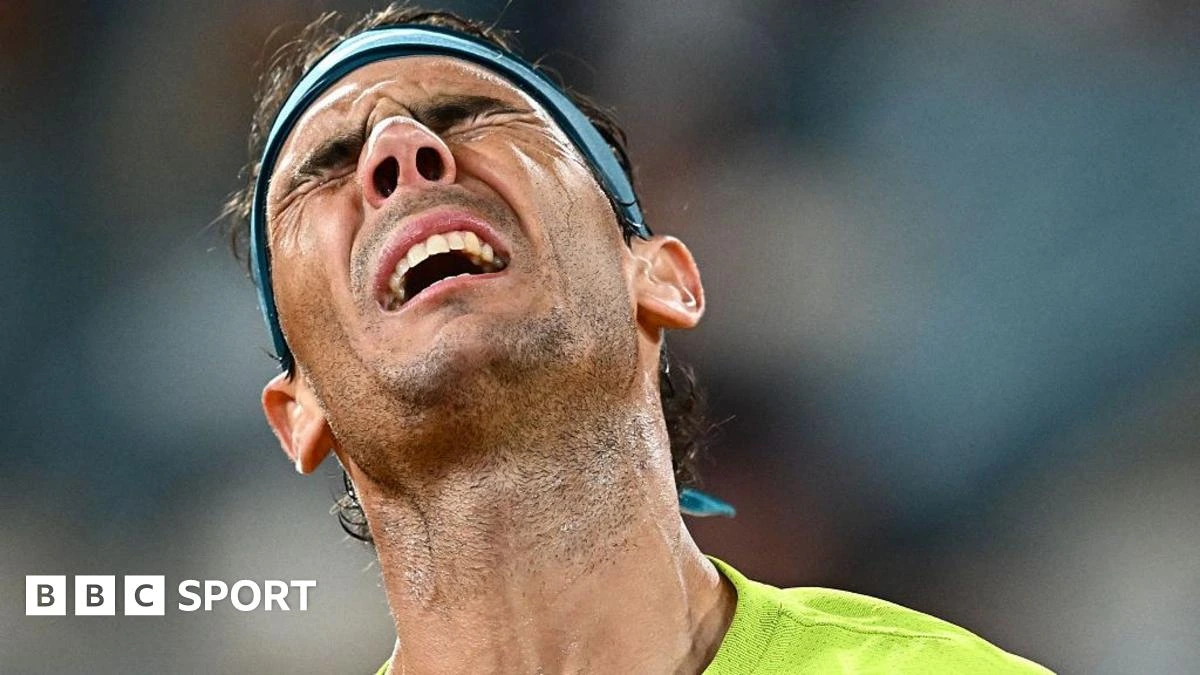
Rafael Nadal had one of the greatest tennis careers the game has ever seen. He also spent nearly all of it in pain.
Between his first French Open win in 2005 and retirement in 2024, the Spaniard won 22 Grand Slam singles titles - the second-highest total of any man.
He was part of the 'Big Three' era, where he, Roger Federer and Novak Djokovic carved up the sport's biggest prizes and thrilled fans.
But a chronic foot injury meant Nadal had to find different ways just to get through matches, let alone win them.
In a new Netflix series, the 39-year-old opens up about the risks he took with his health in order to achieve greatness.
"I've had to make decisions about my health, where you are on the borderline between right or wrong," Nadal said.
"But if I hadn't explored all that, I probably would have had 10 fewer Grand Slams. I'm not saying one or two, I'm saying 10 or 12. This is the reality."
In 2005 the long-haired, muscular teenage sensation announced himself to the world by winning the French Open at his first attempt, beating world number one Roger Federer in the semi-finals on his 19th birthday.
He finished that season ranked second in the world, having won 11 singles titles.
However, it was also the year Nadal's injury struggle began in earnest.
After breaking his left foot during his Madrid Open final victory, Nadal was diagnosed with a rare degenerative condition called Mueller-Weiss syndrome., external
Speaking to the BBC World Service's Sporting Witness programme, Nadal said the foot injury was "the origin of all my problems".
"I had to stay over-positive, over-determined, always ready to try to find a solution to keep being competitive and find a way to be on court again," he said.
"I went through, a couple of times in my career, a long process of injuries, but I think I was ready to accept that moment, to tolerate the frustration and to keep working with hope and passion.
"The key was the suffering was less than than my passion and my happiness for what I was doing."
Hampered Sinner out in second round in seismic shock
Sporting Witness: When Rafael Nadal won Wimbledon
Dr Ernesto Maceira, a specialist who treated the Spaniard's foot, said the condition was caused by "abnormal forces that act on an immature bone" and attributed it to Nadal's intense training as a child.
There were fears he would never play tennis again but, on the suggestion of Maceira, Nadal used a specialist insole to continue competing.
But it meant he lived in constant pain.
"Tennis became a race against time," said Nadal.
"Always having the doubt in my head of, 'how long can I last with this foot?' I never knew how long my career would last.
"I always thought, 'maybe it's the last year, so there's no time to stop'."
The insole also contributed to other health problems. In 2012, Nadal had to pull out of the London Olympics and the US Open because of tendinitis in his left knee.
"My knee was destroyed. The tendon basically had a hole in it," Nadal said.
"Having to play with an insole throughout my entire career threw the rest of my body out of whack."
In 2013, against the advice of a specialist doctor, Nadal decided to compete at the hard-court Indian Wells tournament.
Using anaesthetics to manage the pain in his knee, he won the tournament and went on to win a further nine tournaments that year, as well as winning the French and US Opens to reclaim the world number one ranking from Novak Djokovic.
However, he was using so many anti-inflammatories to manage his left knee pain that it caused other health issues.
"I have two small perforations in my intestines - small perforations that can come from too many painkillers," he said.
At the 2022 French Open, the pain in Nadal's foot was so bad that he asked Dr Angel Ruiz-Cotorro to put the sensory nerve to sleep with targeted anaesthetic injections.
He had no feeling in his foot - and yet he went on to win a record 14th Roland Garros title, the last of his career.
"He doesn't feel his foot and he's winning this?" said seven-time Grand Slam singles champion John McEnroe.
"What are you going to tell me next? He's going to play blindfolded and he's going to win it also?"
The 'tough love' that shaped retiring great Nadal
Seeking professional psychological help
Nadal was coached by his uncle Toni from the age of three with a tough love approach.
Toni himself described denying Nadal water for the first hour of training sessions as a child, "to learn to suffer a bit", as well as encouraging his nephew to play on during a tournament as a child after he had broken his finger.
"I won the tournament, but I had to wear a cast for a month," says Nadal.
Describing the competitor's mentality, physio Rafael Maymo says: "I think he likes to suffer, with the intention of overcoming that suffering."
At one point, however, the pressure on Nadal caused such compulsive behaviour that he sought professional psychological help.
"If I didn't have a bottle of water in my hand, I couldn't swallow and I would choke on my own saliva," he explained.
"I knew it was anxiety, but I couldn't find a solution. I tried to make myself believe that things were getting better, but really I couldn't.
"I did have to go to a psychiatrist. He said it was probably due to all these years of high demand and constantly living with a feeling of stress."
That process led him to add former Spanish world number one Carlos Moya to his coaching staff in December 2016, which ultimately contributed to Toni moving on.
"The relationship with Toni on a professional level wasn't bad, but maybe I needed my head to hear a different message," Nadal explained.
Between 2017 and retiring in 2024, the Spaniard won a further eight Grand Slams.
"I lived the last years of my career with a little more sense of freedom," he said.
Related topics
Live scores, results and order of play
Get tennis news sent straight to your phone